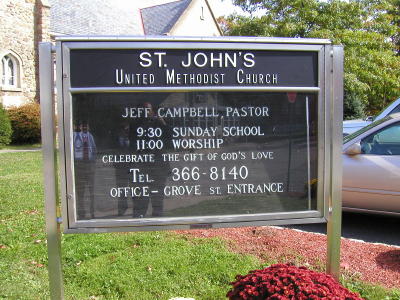
Methodism in Wharton originated when Cornish and Welsh miners came to work in the iron mines, when the general area was known as Irondale. The village took the name of Port Oram upon the completion of the Morris Canal.
These people were steeped in Methodist doctrine having been inspired by the continuing power of the Wesleyan movement in England.
On February 2, 1868, a group met in the public school and organized a Sabbath School. Upon merging with the Mt. Pleasant Sabbath School, Mr. A. A. Trowbridge was elected Superintendent with Mr. Sylvester Kyner, Assistant Superintendent and Librarian.
Later in 1868 a frame church building was erected by the Mt. Pleasant Mining Company and occupied by these people, who organized as the St. John’s Methodist Episcopal Church at Port Oram. Worship was continued in that building until October 24, 1926, when the present edifice was dedicated. In 1902 the name Port Oram was changed to Wharton.
The singing of Cornish Carols at Christmas time was an old English custom enjoyed by the people.
The largest member group formed a town on 28 June,1895 consisting of voters from the settlements of Port Oram, Irondale, Luxemburg, Maryville and Mount Pleasant. These votes covered 2.25 miles of New Jersey. In 1831 the Morris Canal was completed and along it's way to Boonton and Dover from Phillipsburg it touched Morris County and that's where Wharton was. Joseph Wharton (1826-1909) belonged to an old Quaker family first studied at a local school and could not further proceed with college due to health reasons. Alhough he was sent to the farm to recover he pursued his chemistry knowledge at the laboratory of Martin Boye in Philedelphia.
For further information and details please visit the website given below.
About Wharton
(Back to the Top)
|